
A joint strategy and regional action plans to prevent water pollution by medicine residues
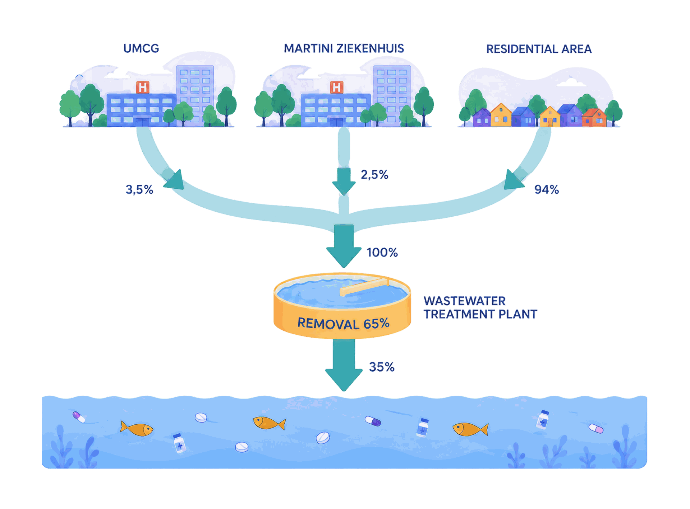
The presence of medicine residues in Northwest European water bodies is a growing concern, worsened by an ageing population and climate change. Medicine residues are an increasingly important source of water pollution across Europe. After use, parts of the medicines leave the body unchanged or as metabolites (partially broken down). These leftovers can ultimately enter waste water and surface waters. Exposure to these residues is linked to abnormalities in aquatic life, the development of antibiotic resistance, and potentially even threats to human health.
Currently, there’s a lack of collaboration between the water and healthcare sectors in the Northwest European region, resulting in strategies not aligned to effectively reduce medicine residues. This first pillar, in a series of three, aims to develop and implement a transnational strategy (to be operationalized through four regional action plans) to sustainably reduce medicine residues in the water bodies of Northwest Europe.
Our approach
The transnational strategy we want to create will focus on the following key themes:
- Reduction of medicine residues in water bodies;
- Promoting sustainable dispensing, use and disposal for all medicines with a focus on a top tier high priority medicines;
- Upscaling available at-source water purification technologies;
- Enhancing cross-border collaboration and knowledge exchange, ensuring access to clean drinking water throughout the Northwest European region.
To achieve this, we’ll benchmark current national and regional policies and mitigation strategies. This includes developing a framework to identify and prioritize medicines with high environmental risk, defining emission hotspots, and creating a toolkit for pharmacy sector-oriented mitigation strategies aimed at pharmacists.

A framework to identify high priority medicines
We aim to develop a framework to identify a top tier list of high priority medicines for monitoring and mitigation actions. Among the thousands of medicinal products authorized across Europe, some substances have been identified as pollutants of concern. These have been included in either the EU Water Framework Directive’s Priority Watchlist or in the EU Watch List for monitoring in surface waters. However, other medicines not included on these lists, might still pose a risk to water quality. This is because of their frequent use or high toxicity to the environment. Due to a lack of data, it’s currently difficult to determine which medicines are most important to monitor and how to efficiently reduce their emissions into water. By creating a framework to identify high-priority medicines, we can focus our efforts where it matters most.
A toolkit for the pharmacy sector
Our findings will be implemented into a toolkit with mitigation strategies tailored for the pharmacy sector. The toolkit will be supported by anonymously aggregated medicine dispensing data and citizen surveys. This will help estimate actual medicine use by patients and clarify the volume of unused dispensed medicines.
At source water purification
All the input gathered at this point will contribute to our next step. In this activity, we will map the current approaches to water quality assessment and monitoring across the different regions. We identify the best available source-based water purification techniques, since purifying water close to the source of pollution can help reduce or prevent medicine residues from entering water bodies
Strategies and action plans
An economic report developed in this activity will serve as a basis for recommending effective and sustainable technological mitigation strategies. The report is directed at regional authorities to reduce water pollution at the source, for example in healthcare institutions. Pharmaceutical pollution affects health- and environmental sectors through reduced quality of life and increased societal costs. Because of this, our recommendations will be supported by a report presenting a framework for the health-economic assessment of pharmacy-oriented mitigation strategies
EU-wide and regional events
Taking shared responsibility for creating and adopting the solutions in this pillar is key. It will help create policies that are more sustainable and easier to implement. To foster this, we will organize several regional policy dialogues and EU-wide events throughout our project. These events will facilitate an open exchange with policymakers. They will help us gain insight into current actions, challenges, policy gaps and ideas for improving regional policy, while also providing an opportunity to share PREWAPHARM results that could be embedded in regional policies or support their implementation.
Policy dialogues and solutions developed within the project will provide the foundation for a transnational strategy and four regional action plans (NL, BE, GER, LU). Building on the expertise gathered during events, further guidance will be provided to support the successful implementation of these policies by healthcare and water management authorities.
Prof. dr. Eelko Hak
Prof. dr. Eelko Hak is a professor of pharmacoepidemiology from the University of Groningen, he leads Pillar 1 and has been leading pharmacy-related environmental research since 2019.